

Sizing, Fit and Walking, Explained by Hannah On Heels
- Posted on
- By Hannahonheels & Pieter
- Posted in Explained
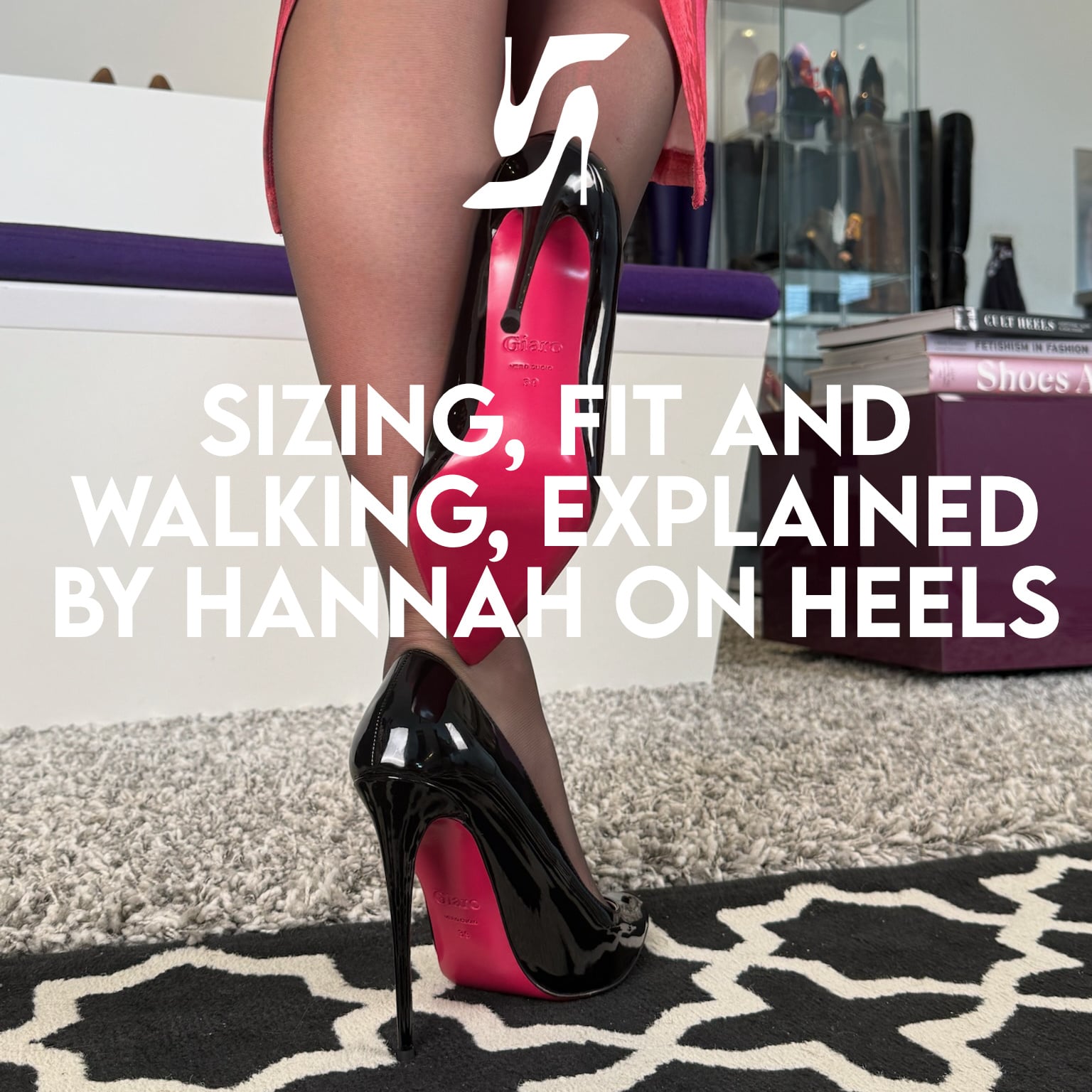
Getting the size right is the single biggest factor in walking well in heels. Not the heel height, not the brand: the fit. We sat down with Hannah, our regular model, to talk through what actually happens to your walk when a heel is too big, and what a correct fit should feel like.
Sizing, Fit and Walking, Explained by Hannah On Heels
Getting the size right is the single biggest factor in walking well in heels. Not the heel height, not the brand: the fit. We sat down with Hannah, our regular model, to talk through what actually happens to your walk when a heel is too big, and what a correct fit should feel like.
What happens when a heel is too big
"If a heel is too big, your foot slides forward with every step," Hannah explains. "The ball of your foot ends up too far into the vamp, into the part of the shoe that's already angled down toward the toe. Your toes end up flat in that angled section instead of stopping where they should. At that point you can't really walk properly anymore."
She describes the compensation most women make without realising it: rolling the foot slightly inward with each step to stop it sliding further forward. "You lose the straight line. If you look at how a heel should move, the tip and the back of the heel should follow a single continuous straight line as you step. When the shoe is too big, you break that line to compensate, and that's what makes the walk look clumsy instead of elegant."
Hannah demonstrates what she means about "losing the straight line" here:
What the correct heel-walking technique looks like
Hannah confirms the heel-first myth is mostly true, but the way you place it depends on the heel height. "For a 10cm or 12cm heel, you can go heel-first and then roll onto the ball, that works fine. On something very high, like the Claudine, you can't come down onto the heel as hard. You need more control, because the angle is so much steeper."
Fit changes this too. "If a shoe is too big and you try to place the heel first, your foot slides forward on impact instead of landing where it should. That's when you end up dragging your shoes instead of stepping in them."
Hannah demonstrates how to walk in a pair of 12cm high heels, heel to toe:
How to check fit when you're trying on a heel
The right amount of snugness depends on the material.
"With leather, the heel shouldn't slip at all when you try it on, because leather will stretch a little over time. If it already slips at the shop, it will only get worse. With synthetic heels, like the ones I'm wearing now from Giaro, there's no stretch to expect, so it needs to fit well from the very first try. It's fine if the shoe is a fraction snug, but it shouldn't pinch your toes within the first few seconds."
A small amount of pressure at the toes is normal and expected. "That's simply what a pointed heel does: your weight shifts forward, so you feel some pressure there. The higher the heel, the more your weight moves forward, so the more pressure you'll feel at the toes."
If a synthetic heel is slightly too loose
Because synthetic materials don't break in the way leather does, a heel that's a touch too loose can't be solved by wearing it in. Hannah's fix: "You can add a small cushion at the front, inside the shoe. It gives the same effect as a leather insole would in a leather shoe: it takes up the extra space so your foot doesn't slide forward."
Why the same size doesn't fit the same way twice
This is where sizing gets genuinely confusing, and Hannah is direct about it: "It's not consistent. A size 38 in one brand is not automatically a size 38 in another. It can even differ between models within the same brand, because the shape of the last is different. If a model gives your foot more room at the back, you'll often need to size down. Toe shape plays a role too: a round toe gives more room than a pointed one, and an open toe gives you more room at the front but less support at the back."
Her advice on sizing charts: "Use them as a starting point, not as a guarantee. They're a guideline, nothing more."
She also pushes back on a common assumption: seeing someone else wear a heel well doesn't tell you how it will fit or move on you. "The same shoe looks completely different on different people, and that has nothing to do with size. It's about how you walk. Everyone has a different gait, a different build, different legs. That's really the deciding factor, not just the number on the box."
- Shop the Giaro High Heels Sale now!
- Sizing, Fit and Walking, Explained by Hannah On Heels
- High Heel Toe Shapes Explained
- The Taya Restock is here!
- How to care for your smooth nappa leather boots: Step by step
- How to change your heel tips: Step by step
- Italian Block Heels have arrived!
- New Italian High Heels
- Shop is open during warehouse move
- Compare Giaro High Heel models